Neurodiverse Marriages And Pets

In my own neurodiverse marriage, pets have played a surprisingly powerful role in creating emotional balance and connection. My husband, who is on the autism spectrum, often finds comfort in the predictable presence of our animals. When words feel hard or emotions run high, the simple act of caring for a pet—feeding, walking, sitting quietly together—can bring a sense of calm and shared purpose without pressure.

From a clinical perspective, this makes sense. Many autistic adults experience animals as regulating rather than demanding. Pets offer companionship without the complexity of social cues, expectations, or emotional interpretation. For neurotypical partners, pets can also serve as a source of comfort and emotional grounding, especially during periods when their spouse may be shut down or overwhelmed. Clinically, I often see pets act as a bridge—reducing tension, increasing routine, and creating moments of connection that don’t rely on verbal processing.

Neurodiverse Marriages And Pets

Pets can also help couples practice attunement and teamwork. Noticing a dog’s anxiety, responding to a cat’s need for space, or coordinating caregiving responsibilities can mirror the skills needed in neurodiverse relationships: observation, flexibility, and respect for differing nervous systems. While pets are not a solution to relational challenges, they can be a quiet, steady support—offering regulation, routine, and moments of closeness that strengthen the emotional fabric of neurodiverse marriages.

Here are some tips for integrating pets into neurodiverse marriages:

1. Choose the Right Pet

Consider the sensory needs and preferences of both partners. Some neurodivergent individuals may be sensitive to certain noises, textures, or smells. If one partner is sensitive to noise, a quiet pet like a fish or a reptile may be more suitable than a barking dog or a vocal bird. It’s important to select a pet that aligns with both partners’ sensory comfort levels.

2. Establish Clear Roles and Responsibilities

Defining roles and responsibilities for pet care is crucial. Discuss and agree upon who will handle feeding, walking, grooming, and cleaning up after the pet. Clear communication can help prevent misunderstandings or frustration, particularly if one partner prefers routine and structure. Visual schedules or reminders can also be beneficial in maintaining consistency.

3. Create a Routine

Many neurodivergent individuals thrive on routine, and pets can help establish a daily structure. Incorporating pet care into the daily routine can provide a sense of stability and predictability. Regular feeding times, walks, and play sessions can help both partners stay organized and reduce anxiety.

4. Recognize the Therapeutic Benefits

Pets can provide emotional support and reduce stress. For neurodivergent individuals, the unconditional love and companionship of a pet can be grounding and calming. Recognizing the emotional benefits pets bring can enhance the overall well-being of both partners.

5. Be Mindful of Overwhelm

While pets can be a source of joy, they can also be overwhelming at times. It’s important to recognize when one partner might feel overstimulated by the pet and to provide space or time away as needed. Having a designated quiet area or pet-free zone can help manage sensory overload.

6. Foster Teamwork and Bonding

Caring for a pet can be a shared experience that strengthens the bond between partners. Engaging in activities such as training sessions, playing games, or attending pet-friendly outings together can foster teamwork and enhance the connection within the relationship.

By being mindful of each partner’s needs and preferences, pets can be a positive and supportive addition to neurodiverse marriages, enhancing emotional well-being and strengthening the relationship.

In addition, my book The Happy Neurodiverse Marriage has practical tools to help establish emotional connection and ensure effective communication.

For more information about neurodiverse marriages contact me CouplesCounselorSanDiego.com or call (858) 735-1139


Emotional Support: How Riley Helps When Love Feels Lonely

Emotional Support: How Riley Helps When Love Feels Lonely. Fourteen years ago, I didn’t know my husband was on the spectrum. At the time, I experienced what I now recognize as major Cassandra symptoms—feeling unseen, misunderstood, and emotionally drained in our marriage. My feelings of disconnect were unbearable and I was questioning whether I should stay or go in this marriage. We decided to get a dog, Riley, my 14-year-old Yorkie, to help support me through those overwhelming emotions.

Emotional Support: How Riley Helps When Love Feels Lonely

Riley quickly became more than an emotional support pet—he’s a constant companion, a playful presence, and a source of comfort and joy. His energy, curiosity, and affectionate nature remind me that companionship doesn’t always come from human interaction. His excitement when I come home, little nudges for attention, and the way he curls up beside me when I feel disconnected create a sense of presence and unconditional love that’s easy to feel. He doesn’t require me to explain my emotions or navigate miscommunications—he simply responds to my mood with warmth and acceptance.

Emotional Support: How Riley Helps When Love Feels Lonely

When life or my relationship feels challenging, Riley helps regulate my emotions. Riley is part of my self-care. Walking him, playing with him, or even just sitting quietly while he rests in my lap allows me to slow down, release tension, and feel nurtured. He teaches me to stay present, notice small joys, and breathe through difficult moments—lessons that directly improve my ability to reconnect with my husband.

Pets like Riley can’t solve every relationship challenge, but they provide companionship, laughter, and grounding that nourish the heart. In a neurodiverse marriage, where emotional gaps can feel wide, the steady, joyful presence of a dog can make all the difference. Riley shows me every day that even when love feels lonely, it’s still very much alive.

If you are navigating a neurodiverse marriage, I invite you to reach out or explore my book, The Happy Neurodiverse Marriage: Six Tools for Communication and Emotional Connection With Your Asperger Husband.For counseling and support, visit couplescounselorsandiego.com 

Or text me at (858) 735-1139 for information about my services and fees.

Neurodiversity: What It Really Means—and Why It’s Not a Diagnosis

Neurodiversity: What It Really Means—and Why It’s Not a Diagnosis. The word neurodiversity is often misunderstood. For many autistic individuals and their partners, it can feel like just another label—another way of saying “something is wrong.” That was certainly my experience before I understood that my husband was on the autism spectrum.

Neurodiversity: What It Really Means—and Why It’s Not a Diagnosis

Before that understanding, many of his traits were easy to misinterpret. His direct communication felt blunt. His limited facial expression and eye contact registered as emotional distance. His need for routine seemed rigid. When he withdrew after social interactions, I assumed he didn’t care or wasn’t invested. I viewed these behaviors through a neurotypical lens that quietly asked, Why is this so hard?

Learning about neurodiversity changed everything.

Neurodiversity is not a diagnosis; it is a framework. It recognizes that human brains vary naturally, just as personalities and cultures do. Autism is not a flaw to be fixed—it is a different neurotype with its own ways of processing, regulating, and connecting.

Through this lens, what once looked like rudeness became honesty. What felt like indifference was often slower emotional processing. Intense focus wasn’t self-absorption but deep engagement. Sensory sensitivities weren’t overreactions—they were real nervous-system responses. Most importantly, I learned that a lack of visible emotion did not mean a lack of feeling.

This reframing did not erase real challenges. But it replaced blame with context, and resentment with understanding. Support shifted from trying to change my husband to learning how to meet each other where we actually are.

That is why tools matter. Neurodiverse couples often need different tools to communicate effectively and feel emotionally connected. Seeking professional help is not a failure or a source of shame—it is a thoughtful, proactive, and commendable step toward a healthier relationship.

If you are navigating a neurodiverse marriage, I invite you to reach out. I am a marriage and family therapist specializing in neurodiverse couples, and these approaches are also outlined in my book, The Happy Neurodiverse Marriage: Six Tools for Communication and Emotional Connection With Your Asperger Husband.

Takeaway: Understanding neurodiversity opens the door—but the right tools help you walk through it together.

Neurology matters. Many neurodiverse couples struggle not from lack of effort, but because traditional marriage counseling is based on neurotypical assumptions. Neurodiverse couples often need different tools to communicate effectively and feel emotionally connected. Seeking specialized professional help is not a failure or a source of shame—it is a thoughtful and commendable step. Working with someone who understands neurodiversity, both clinically and personally, can make a meaningful difference.

If you are navigating a neurodiverse marriage, I invite you to reach out or explore my book, The Happy Neurodiverse Marriage: Six Tools for Communication and Emotional Connection With Your Asperger Husband.For counseling and support, visit couplescounselorsandiego.com 

Or text me at (858) 735-1139 for information about my services and fees.

Neurodiverse Marriages: Cassandra and Pets as Therapy

Neurodiverse Marriages: Cassandra and Pets as Therapy. In neurodiverse marriages, the emotional reality of the neurotypical partner is often invisible. Many NT spouses—most often wives—experience what’s known as the Cassandra phenomenon: chronic loneliness, emotional invalidation, and the painful sense of not being truly seen or heard, even in a committed relationship. Over time, this can lead to grief, depression, and self-doubt.

Neurodiverse Marriages: Cassandra and Pets as Therapy

In my clinical work with neurodiverse couples—and in my own marriage—I see this pattern frequently. The ASD partner is rarely intentionally withholding care. Instead, differences in emotional processing, empathy expression, and communication styles can leave the NT partner carrying the emotional labor alone. When this dynamic goes unspoken, the nervous system stays in a state of quiet distress.

Pets can play an unexpectedly therapeutic role in this landscape.

I remember a moment in my own marriage when my husband, watching the attention I gave our dog Riley, asked me, “How can I get the same attention Riley gets?” My answer was simple and honest: proximity. Riley comes close. He sits next to me. He makes himself emotionally and physically present without needing words. That closeness invites connection.

For many NT partners experiencing Cassandra symptoms, pets offer consistent affection, emotional responsiveness, and nonverbal attunement. A dog leaning in, a cat curling up nearby, or the rhythm of daily care can regulate the nervous system and ease loneliness. Pets notice distress and respond instinctively—something many NT partners deeply miss.

From a therapeutic lens, pets reduce stress hormones and provide moments of co-regulation. They restore a sense of being seen and emotionally significant.

Pets are not a substitute for relational work, but they are powerful support. When paired with explicit tools—check-ins, scales, and clear communication—connection can grow.

Takeaway: Healing in neurodiverse marriages often begins with presence. Sometimes, it’s as simple—and as hard—as choosing proximity.

You can learn more in my book, The Happy Neurodiverse Marriage: Six Tools for Communication and Emotional Connection With Your Asperger Husband, available on Amazon.
For counseling and support, visit couplescounselorsandiego.com 

Or text me at (858) 735-1139 for information about my services and fees.

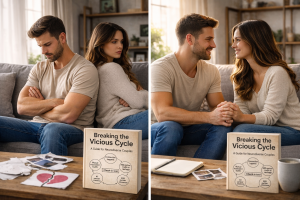
Neurodiverse Marriages: Breaking the Vicious Cycle After Winter Break

Neurodiverse Marriages: Breaking the Vicious Cycle After Winter Break. Winter break can be a beautiful time—family gatherings, altered routines, late nights—but for neurodiverse marriages, it can also be exhausting. When kids return to school, many couples expect immediate relief. Instead, what often shows up is emotional distance, irritability, or a sense of disconnection.

Neurodiverse Marriages: Breaking the Vicious Cycle After Winter Break

This is normal.

Extended breaks disrupt structure, increase sensory input, and require more emotional energy. In neurodiverse marriages, partners recover differently. One partner may need quiet, predictability, and time alone to regulate. The other may feel ready to reconnect, talk, and rebuild closeness. When these needs aren’t named, a vicious cycle can quietly begin.

In our marriage, I’ve lived this pattern. Once the kids are back at school, Phil immediately returns to his routines. From his perspective, this is how he regulates and recovers. From mine, it can feel like the momentum we built during connection days over break suddenly disappears. If we wait too long to intentionally reconnect, Cassandra symptoms can emerge—loneliness, self-doubt, emotional exhaustion—and the relationship can spiral downward.

One of the fastest ways to break this vicious cycle is using the Check-In Tool from The Happy Neurodiverse Marriage. A check-in isn’t about solving problems or having a heavy conversation. It’s a brief, structured pause where each partner shares how regulated they feel, what their nervous system needs, and whether connection or space is most supportive right now. This simple exchange can immediately reset assumptions and prevent emotional misinterpretation.

Breaking the cycle also means resetting expectations. Don’t assume the return to school automatically restores balance. Ask instead: How depleted are we? What does each of us need to recover?

Next, re-establish routines—gently. Choose one or two anchors—quiet mornings, predictable evenings—rather than jumping back into full schedules.

Finally, prioritize low-demand connection. Short moments of presence often matter more than long talks during transitions.

Takeaway: Back-to-school is a recalibration period for neurodiverse marriages. Using tools like intentional check-ins early can break the vicious cycle before Cassandra symptoms take hold—and help couples reconnect with clarity and compassion.

If you are navigating a neurodiverse marriage, I invite you to reach out or explore my book, The Happy Neurodiverse Marriage: Six Tools for Communication and Emotional Connection With Your Asperger Husband.For counseling and support, visit couplescounselorsandiego.com 

Or text me at (858) 735-1139 for information about my services and fees.