Neurodiversity: What It Really Means—and Why It’s Not a Diagnosis

Neurodiversity: What It Really Means—and Why It’s Not a Diagnosis. The word neurodiversity is often misunderstood. For many autistic individuals and their partners, it can feel like just another label—another way of saying “something is wrong.” That was certainly my experience before I understood that my husband was on the autism spectrum.

Neurodiversity: What It Really Means—and Why It’s Not a Diagnosis

Before that understanding, many of his traits were easy to misinterpret. His direct communication felt blunt. His limited facial expression and eye contact registered as emotional distance. His need for routine seemed rigid. When he withdrew after social interactions, I assumed he didn’t care or wasn’t invested. I viewed these behaviors through a neurotypical lens that quietly asked, Why is this so hard?

Learning about neurodiversity changed everything.

Neurodiversity is not a diagnosis; it is a framework. It recognizes that human brains vary naturally, just as personalities and cultures do. Autism is not a flaw to be fixed—it is a different neurotype with its own ways of processing, regulating, and connecting.

Through this lens, what once looked like rudeness became honesty. What felt like indifference was often slower emotional processing. Intense focus wasn’t self-absorption but deep engagement. Sensory sensitivities weren’t overreactions—they were real nervous-system responses. Most importantly, I learned that a lack of visible emotion did not mean a lack of feeling.

This reframing did not erase real challenges. But it replaced blame with context, and resentment with understanding. Support shifted from trying to change my husband to learning how to meet each other where we actually are.

That is why tools matter. Neurodiverse couples often need different tools to communicate effectively and feel emotionally connected. Seeking professional help is not a failure or a source of shame—it is a thoughtful, proactive, and commendable step toward a healthier relationship.

If you are navigating a neurodiverse marriage, I invite you to reach out. I am a marriage and family therapist specializing in neurodiverse couples, and these approaches are also outlined in my book, The Happy Neurodiverse Marriage: Six Tools for Communication and Emotional Connection With Your Asperger Husband.

Takeaway: Understanding neurodiversity opens the door—but the right tools help you walk through it together.

Neurology matters. Many neurodiverse couples struggle not from lack of effort, but because traditional marriage counseling is based on neurotypical assumptions. Neurodiverse couples often need different tools to communicate effectively and feel emotionally connected. Seeking specialized professional help is not a failure or a source of shame—it is a thoughtful and commendable step. Working with someone who understands neurodiversity, both clinically and personally, can make a meaningful difference.

If you are navigating a neurodiverse marriage, I invite you to reach out or explore my book, The Happy Neurodiverse Marriage: Six Tools for Communication and Emotional Connection With Your Asperger Husband.For counseling and support, visit couplescounselorsandiego.com 

Or text me at (858) 735-1139 for information about my services and fees.

Neurodiverse Marriages: Cassandra and Pets as Therapy

Neurodiverse Marriages: Cassandra and Pets as Therapy. In neurodiverse marriages, the emotional reality of the neurotypical partner is often invisible. Many NT spouses—most often wives—experience what’s known as the Cassandra phenomenon: chronic loneliness, emotional invalidation, and the painful sense of not being truly seen or heard, even in a committed relationship. Over time, this can lead to grief, depression, and self-doubt.

Neurodiverse Marriages: Cassandra and Pets as Therapy

In my clinical work with neurodiverse couples—and in my own marriage—I see this pattern frequently. The ASD partner is rarely intentionally withholding care. Instead, differences in emotional processing, empathy expression, and communication styles can leave the NT partner carrying the emotional labor alone. When this dynamic goes unspoken, the nervous system stays in a state of quiet distress.

Pets can play an unexpectedly therapeutic role in this landscape.

I remember a moment in my own marriage when my husband, watching the attention I gave our dog Riley, asked me, “How can I get the same attention Riley gets?” My answer was simple and honest: proximity. Riley comes close. He sits next to me. He makes himself emotionally and physically present without needing words. That closeness invites connection.

For many NT partners experiencing Cassandra symptoms, pets offer consistent affection, emotional responsiveness, and nonverbal attunement. A dog leaning in, a cat curling up nearby, or the rhythm of daily care can regulate the nervous system and ease loneliness. Pets notice distress and respond instinctively—something many NT partners deeply miss.

From a therapeutic lens, pets reduce stress hormones and provide moments of co-regulation. They restore a sense of being seen and emotionally significant.

Pets are not a substitute for relational work, but they are powerful support. When paired with explicit tools—check-ins, scales, and clear communication—connection can grow.

Takeaway: Healing in neurodiverse marriages often begins with presence. Sometimes, it’s as simple—and as hard—as choosing proximity.

You can learn more in my book, The Happy Neurodiverse Marriage: Six Tools for Communication and Emotional Connection With Your Asperger Husband, available on Amazon.
For counseling and support, visit couplescounselorsandiego.com 

Or text me at (858) 735-1139 for information about my services and fees.

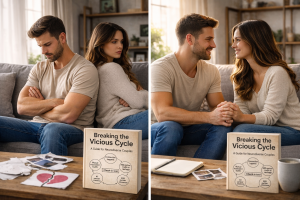
Neurodiverse Marriages: Breaking the Vicious Cycle After Winter Break

Neurodiverse Marriages: Breaking the Vicious Cycle After Winter Break. Winter break can be a beautiful time—family gatherings, altered routines, late nights—but for neurodiverse marriages, it can also be exhausting. When kids return to school, many couples expect immediate relief. Instead, what often shows up is emotional distance, irritability, or a sense of disconnection.

Neurodiverse Marriages: Breaking the Vicious Cycle After Winter Break

This is normal.

Extended breaks disrupt structure, increase sensory input, and require more emotional energy. In neurodiverse marriages, partners recover differently. One partner may need quiet, predictability, and time alone to regulate. The other may feel ready to reconnect, talk, and rebuild closeness. When these needs aren’t named, a vicious cycle can quietly begin.

In our marriage, I’ve lived this pattern. Once the kids are back at school, Phil immediately returns to his routines. From his perspective, this is how he regulates and recovers. From mine, it can feel like the momentum we built during connection days over break suddenly disappears. If we wait too long to intentionally reconnect, Cassandra symptoms can emerge—loneliness, self-doubt, emotional exhaustion—and the relationship can spiral downward.

One of the fastest ways to break this vicious cycle is using the Check-In Tool from The Happy Neurodiverse Marriage. A check-in isn’t about solving problems or having a heavy conversation. It’s a brief, structured pause where each partner shares how regulated they feel, what their nervous system needs, and whether connection or space is most supportive right now. This simple exchange can immediately reset assumptions and prevent emotional misinterpretation.

Breaking the cycle also means resetting expectations. Don’t assume the return to school automatically restores balance. Ask instead: How depleted are we? What does each of us need to recover?

Next, re-establish routines—gently. Choose one or two anchors—quiet mornings, predictable evenings—rather than jumping back into full schedules.

Finally, prioritize low-demand connection. Short moments of presence often matter more than long talks during transitions.

Takeaway: Back-to-school is a recalibration period for neurodiverse marriages. Using tools like intentional check-ins early can break the vicious cycle before Cassandra symptoms take hold—and help couples reconnect with clarity and compassion.

If you are navigating a neurodiverse marriage, I invite you to reach out or explore my book, The Happy Neurodiverse Marriage: Six Tools for Communication and Emotional Connection With Your Asperger Husband.For counseling and support, visit couplescounselorsandiego.com 

Or text me at (858) 735-1139 for information about my services and fees.

The New Year and Connection: Managing Transitions in Neurodiverse Marriages

The New Year and Connection: Managing Transitions in Neurodiverse Marriages. The New Year often brings the promise of a fresh start—but for neurodiverse couples, it can also bring challenges. Changes in routine, social events, or family expectations may feel overwhelming. Yet, when approached intentionally, transitions can actually strengthen connection and understanding between partners.

The New Year and Connection: Managing Transitions in Neurodiverse Marriages

From my 15 years of experience, both clinically and personally, I’ve seen that transition-focused discussions—rather than rushing to resolve every issue—help couples grow closer. For example, after the holidays, my husband often needed quiet time to recharge, while I wanted to process the season. Simply saying, “I need a calm weekend” or “Can we talk about the holidays?” prevented tension and created understanding.

Tips for Navigating New Year Transitions

1. Check in early: Ask, “How are you feeling about this change?” to build empathy and awareness.
2. Honor energy differences: Recognize that one partner may need downtime while the other seeks engagement, and plan accordingly.
3. Use communication tools: Tools like the Check-In and Perspectives tools from The Happy Neurodiverse Marriage help couples express feelings clearly. For instance, rating emotional energy from 1–10 can guide who leads tasks or social planning.

Takeaway: Transitions aren’t problems to fix—they’re opportunities to deepen connection, practice empathy, and enter the New Year stronger as a team.

In neurodiverse marriages, the goal isn’t to “fix” transitions—it’s to talk through them together. When couples shift their focus from New Year’s resolutions to intentional transition discussions, they reduce misunderstandings, honor different nervous systems, and strengthen emotional connection. Small, consistent conversations during times of change can create stability, trust, and closeness that lasts far beyond the New Year.

If you are navigating a neurodiverse marriage, I invite you to reach out or explore my book, The Happy Neurodiverse Marriage: Six Tools for Communication and Emotional Connection With Your Asperger Husband.For counseling and support, visit couplescounselorsandiego.com 

Or text me at (858) 735-1139 for information about my services and fees.

Neurodiverse Marriages: Reflecting on the Past Year

Neurodiverse Marriages: Reflecting on the Past Year. Neurodiverse marriages offer unique opportunities for growth, connection, and learning—especially when reflecting on the past year. These relationships, where one or both partners are neurodivergent, often face challenges that traditional counseling may not fully address, as neurology matters. Taking time to review the year helps couples notice patterns, celebrate progress, and set intentions for the year ahead.

Neurodiverse Marriages: Reflecting on the Past Year

In my own marriage, we faced familiar challenges: communication breakdowns, misreading emotions, sensory overloads, and differences in routines. Early in the year, I often felt frustrated when my husband seemed emotionally distant or rigid, while he sometimes felt criticized or pressured. I had to manage some Cassandra symptoms but over time, we learned to work through these challenges using specific tools. Regular check-ins help us express needs without blame. Emotional scales allow us to gauge stress and avoid misunderstandings. Perspective-taking exercises remind us to see each other’s experiences clearly.

Other challenges included navigating social events and parenting decisions. We tackled these by planning ahead, setting boundaries, and using clear, direct communication. Even small routines—like scheduled quiet time or shared hobbies—created surprising opportunities for connection. Children and pets also mirrored the shifts, reinforcing positive changes in family dynamics.

Reflection guides goals for the year ahead: What worked? What patterns need adjusting? Neurodiverse marriages benefit from intentional reflection because neurology matters—standard advice often misses the mark.

Having the right tools and professional guidance isn’t a weakness—it’s a commitment. Investing in understanding and connection can turn even a challenging year into a foundation for growth and deeper emotional connection.

Takeaway: Reflect intentionally, celebrate wins, address challenges with clear tools, and prioritize understanding. Neurodiverse marriages thrive when communication, routines, and emotional connection are actively nurtured.

If you are navigating a neurodiverse marriage, I invite you to reach out or explore my book, The Happy Neurodiverse Marriage: Six Tools for Communication and Emotional Connection With Your Asperger Husband.For counseling and support, visit couplescounselorsandiego.com 

Or text me at (858) 735-1139 for information about my services and fees.